


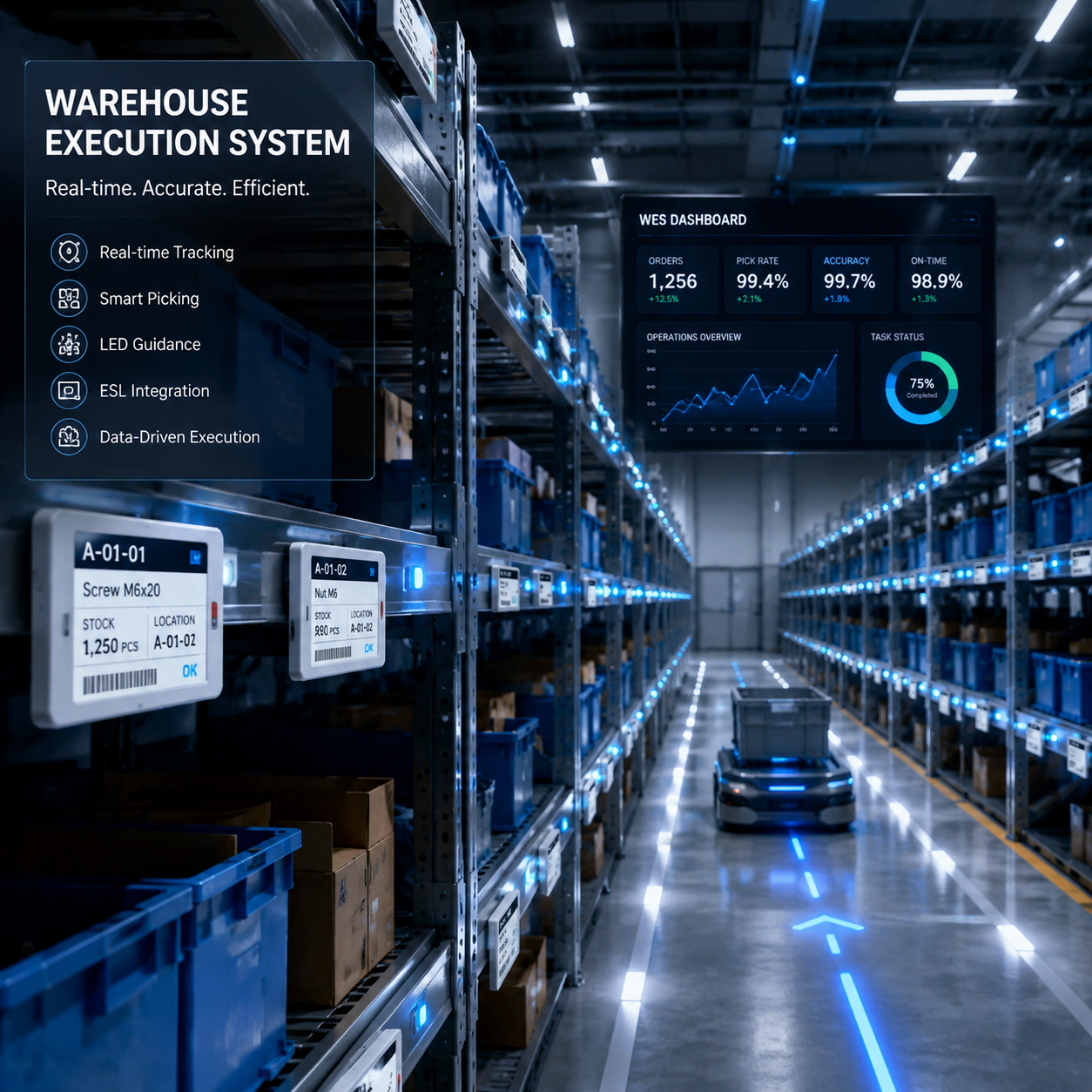
Modern warehouses are no longer just storage spaces. They are execution environments where speed, accuracy, and coordination directly impact cost and delivery performance.
A Warehouse shelf labeling system is not simply a digital label upgrade. It is a real-time execution layer that converts WMS instructions into physical actions inside the warehouse.
Why Warehouse Problems Are Not Inventory Problems
Most warehouse inefficiencies are often misdiagnosed as inventory issues. In reality, the core problem is execution friction.
Workers constantly face:
- Unclear picking routes
- Manual interpretation of documents
- Delayed task updates
- No real-time location guidance
- High dependency on experience-based navigation
This creates a gap between system instructions and physical execution.
What a Warehouse Shelf Labeling System Actually Does
A Warehouse shelf labeling system acts as a bridge between digital instructions and physical operations.
Instead of relying on paper or barcode-only scanning, it uses electronic shelf labels, base stations, and visual guidance systems to coordinate warehouse actions in real time.
In solutions developed by Hipoink, the system is built as a full execution architecture:
- Electronic Shelf Labels (ESL) for dynamic storage information
- Base Station for stable signal distribution
- Passage Lights for visual picking guidance
- ESL system connected directly with WMS/ERP
This creates a synchronized loop between software and warehouse floor execution.
How the System Works
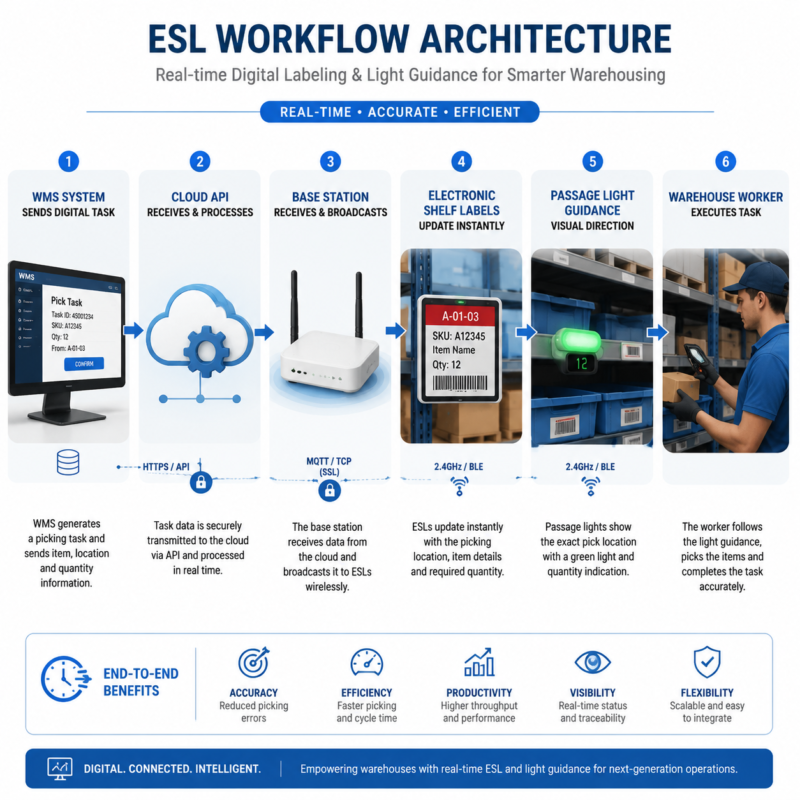
The warehouse shelf labeling system follows a closed-loop execution process:
- WMS sends task instructions (picking, storage, routing)
- ESL system decodes and distributes commands
- Base station transmits signals across warehouse zones
- Shelf labels update instantly with task data
- Passage lights guide operator movement
- Worker confirms actions via label buttons or PDA
- Feedback returns to WMS in real time
This eliminates interpretation delays and reduces operational ambiguity.
Warehouse ESL vs Traditional Warehouse Systems
Traditional systems:
- Barcode scanning required at every step
- Static labels with no dynamic updates
- Manual navigation between shelves
- High dependency on worker experience
Warehouse ESL system:
- Real-time instruction display
- Visual guidance via passage lights
- Automated WMS synchronization
- Reduced decision-making time on the floor
The key difference is simple:
Traditional systems record work
ESL systems guide work in real time
Core Use Cases in Smart Warehousing
Picking Optimization
Operators are guided directly to the correct shelf location using visual signals and dynamic labels.
Storage Accuracy
Shelf labels display real-time SKU and storage data, reducing misplacement.
Dispatch Acceleration
Task instructions are updated instantly based on WMS priority changes.
Training Efficiency
New workers can operate with minimal training due to visual guidance systems.
Core Technology Inside Hipoink Warehouse ESL System
A warehouse execution system depends heavily on communication stability and hardware reliability.
The solution from Hipoink is built on:
- 2.4GHz dedicated communication network for stable warehouse coverage
- Low-power electronic shelf labels optimized for industrial use
- Passage light modules for directional execution guidance
- Multi-node base station deployment (ceiling/wall/floor)
- Open API/SDK integration for WMS and ERP systems
This ensures consistent performance even in high-density warehouse environments.
FAQ
Q1: What is a warehouse shelf labeling system used for?
It is used to convert WMS instructions into real-time physical execution using electronic shelf labels and visual guidance systems inside warehouses.
Q2: Does a warehouse ESL system integrate with WMS?
Yes. Advanced systems support API and SDK integration, allowing real-time synchronization between WMS tasks and warehouse execution devices.
Conclusion
A Warehouse shelf labeling system is not just a labeling upgrade. It is a real-time execution infrastructure that transforms how warehouses operate.
Instead of relying on manual interpretation, it turns digital instructions into physical guidance, reducing delays, errors, and operational friction.
As a leading hardware pioneer with a full-stack in-house electronic paper supply chain, Hipoink ensures that every warehouse ESL system is manufactured under strict ISO9001 standards with an ultra-low hardware defect rate (<500 PPM).
This industrial-grade reliability allows businesses to deploy large-scale digital warehouse systems globally with confidence, stability, and long-term scalability.